
“Royalty and other revenue share obligations can lead to disputes. The solution is detail.”
[David Tollen, in The Tech Contracts Handbook: Cloud Computing Agreements, Software Licenses, and Other IT Contracts for Lawyers and Businesspeople, Third Edition (ABA Publishing/IP Section 2021), Pt. I.G.2.]
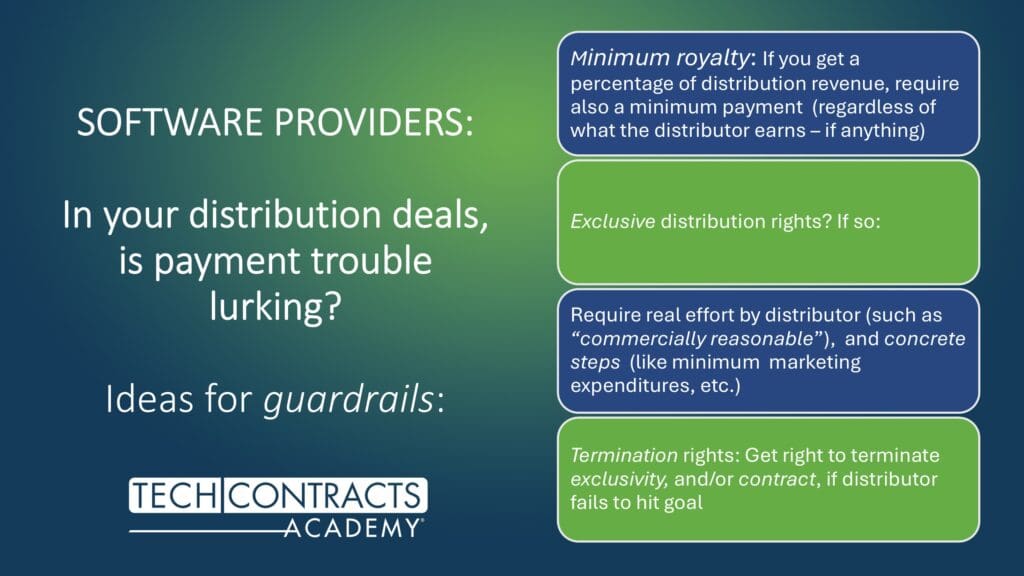
Today we offer some tips to protect software providers from certain payment-related risks in distribution deals, where the distributor fails to earn what the provider was expecting:
- Software distributors often pay the software providers a percentage of revenues collected from end customers. But what if little (or no) revenue is collected?
- Solution: Minimum royalty payments.
- Many software distribution contracts provide an exclusive license to distribute. But what if the distributor fails to market, or sell, the software as you intended (or at all?)
- Solution: Guardrails like “commercially reasonable efforts,” concrete sales/marketing obligations, provider’s termination right (of exclusivity of license, and/or contract altogether).
These tips are for any software provider retaining another company as a distributor. That includes value-added reseller (VAR) and original equipment manufacturer (OEM) deals.
- If you get a percentage of distributor revenues, set a minimum royalty, in dollars.
Imagine the contract says the software provider gets a 20% royalty on sales of its software (or sales of the distributor’s VAR or OEM product containing the provider’s software). The distributor makes sales and charges its customers … little or nothing. The software provider gets (a) 20% of little or (b) 20% of nothing (hint: nothing).
Why would the distributor do that?
It might sell for chump-change as part of a larger deal — one that includes its other products. Or it might give the product away as a promotion.
Solution:
The solution is a minimum royalty clause, such as: “Distributor shall pay Provider a royalty of 20% of gross revenues[1] received for the Software, provided such royalty will not fall below $__ per copy of the Software distributed, regardless of the revenues (if any) collected by Distributor.”
That should solve it (and without violating antitrust law).[2]
For more discussion of this topic, see The Tech Contracts Handbook, Part I.G.2. And for its sample clauses (some with more detail, and variations), see our website’s (free) sample clause library here: Distributors’ and Resellers’ Payments
- If you grant exclusive rights to distribute, add guardrails, like “reasonable efforts,” concrete sales/marketing obligations, and/or termination rights
What if the software provider grants exclusive distribution rights in a territory or worldwide … and its distributor doesn’t work hard on sales? You’ve basically shelved your software.
Solution #1: The provider can improve its situation by including the ever-popular (yet never clear) reasonable efforts, or commercially reasonable efforts requirement. Something like, “Distributor shall exercise reasonable efforts to market and sell the Software.”
That’s doesn’t clearly demand the sales efforts the provider wants. But if the distributor just doesn’t bother, it’s in breach. And if the distributor tries but not much … it could be in breach, and the provider wants that risk to worry the distributor.
The software provider can get more protection by also adding language with more specific terms. Some ideas:
Solution #2: The provider could require the distributor to meet concrete sales and marketing obligations, like making a minimum number of sales calls, or spending at least $X on marketing, etc.
For a sample clause exploring this approach, see the 2nd clause here: Minimum Obligations to Distribute. But, know that this sort of clarity may not be available. The parties may find it difficult to agree on minimum terms. (For more discussion of this topic, see The Tech Contracts Handbook, Part II.G.)
Solution #3: The provider could get the right to terminate the contract if the distributor misses a sales mark.
For example, “If Distributor fails to collect gross revenues of $___ from Software distribution during any calendar year, Provider may terminate this Agreement by written notice to Distributor during the January of the following calendar year.”
Or, the clause could be modified so the provider could at least get the right to terminate the exclusivity of the distribution license.
______________________________________________________________________________________________________________
To learn more: Please check out The Tech Contracts Master Class™, which in 8 hours covers many essential IT contract terms, including about software licensing and distribution, and AI. See also The Tech Contracts Handbook, and our (free) sample clause library.[3]
_______________________________________________________________________________________________________________
Notes:
[1] When a percentage of “revenue” is involved, both parties should specify what that means in this deal. (Gross? Net? If net, after what is deducted (taxes, commissions, etc.?) Is it only revenue for this purpose, if actually received?) See discussion in The Tech Contracts Handbook, Part I.G.2.
[2] You might think you could instead give the distributor a minimum sales price. Red flag. Talk to an antitrust/unfair competition lawyer – fixing a price has high odds of violating antitrust law (“price fixing”).
[3] See here for updates/errata, including to certain sample clauses like the 2nd in Part I.G.2.
_______________________________________________________________________________________________________________
Tech Contracts Academy®, LLC is not a law firm, does not provide legal services, and its publications and courses are for general informational purposes only. They are not to be considered and do not provide legal advice. THIS ARTICLE IS NOT LEGAL ADVICE. IT IS GENERAL IN NATURE AND MAY NOT BE SUFFICIENT FOR A SPECIFIC CONTRACTUAL, TECHNOLOGICAL, OR LEGAL PROBLEM OR DISPUTE, AND IT IS NOT PROVIDED WITH ANY GUARANTEE, WARRANTY, OR REPRESENTATION. LEGAL SITUATIONS VARY, SO BEFORE ACTING ON ANY SUGGESTION IN THIS ARTICLE, YOU SHOULD CONSULT A QUALIFIED ATTORNEY REGARDING YOUR SPECIFIC MATTER OR NEED. Course participation is subject to Terms of Use and Privacy Policies, available for review prior to purchase. Course details are subject to change.
© 2026 Tech Contracts Academy®, LLC. All rights reserved.